What is Himalayan sound healing?
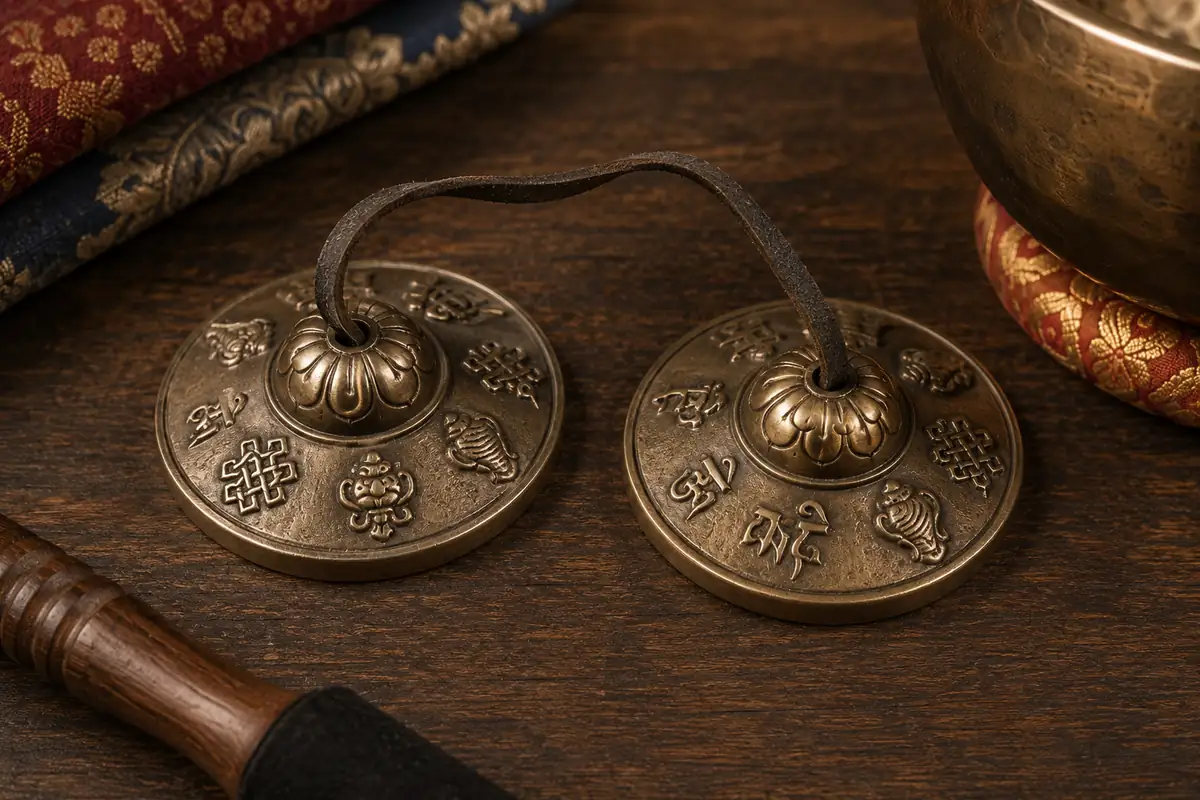
Himalayan sound healing is a practice in which hand-hammered metal singing bowls, gongs, tingsha and chimes are played around a person who is lying down, so that steady tone and vibration help the body settle into deep rest. In Nepal it belongs to a living cultural and spiritual tradition rather than to medicine. It is offered for relaxation, calm and peace of mind — nothing more, and nothing less.
A session is not a performance and it is not a massage. You are not asked to concentrate, to visualise anything, or to believe anything at all. You lie still, warm and fully clothed, and sound is made around you for an hour. The session is arranged around a place somewhere between sleeping and waking. Most of what it offers happens there.
People come to us for very ordinary reasons. They are not sleeping. Work has been heavy for a long time. They have been travelling and their body has not caught up. Something difficult has happened and they would like an hour where nothing is required of them. These are good reasons, and they are the reasons this practice is well suited to.
Where do singing bowls really come from?
The bowls sold worldwide as “Tibetan singing bowls” have overwhelmingly been made in Nepal. Nepali artisan families hammer them by hand from a metal alloy, working the sheet hot and turning it under the hammer until the wall thickness is right and the bowl sings. Kathmandu and the surrounding valley towns have supplied metalwork to monasteries across the Himalaya for many centuries — the Tibetan side had the patronage, and the Newar craftsmen of this valley had the hands.
The name is worth being straight about. Historical accounts of Tibetan music from the early twentieth century, and the records left by early travellers who documented healing practices in Tibet, do not describe singing bowls being used in the way they are used today. The strong likelihood is that “Tibetan singing bowl” is a later commercial name, attached in Western markets from roughly the 1970s onward, rather than a description of where the objects were made or how they were traditionally used.
We call them Himalayan bowls. It is more accurate, and it gives credit to the people who actually make them. If you walk through Patan or the older lanes of Kathmandu you can still hear the hammering.
What happens during a sound healing session?
-
Before
A few quiet minutes
We sit and talk briefly about how you are and anything we should know. If it is your first time we show you the instruments and let you touch them — knowing what is about to make a noise near your head is calming.
-
Settling
You lie down, fully clothed
A mat, a blanket, something soft under your head. Shoes off. No oil, no pressure, nothing that asks you to undress.
-
First ten minutes
Almost nothing happens
Tingsha once, then a long silence. Then a single bowl, left to fade completely before the next sound. This is deliberate: the body will not let go until it is convinced nothing is going to startle it.
-
Opening out
Bowls come in around you
Behind the head, at the sides, near the feet. Some struck, some rimmed with a wooden wand so the tone rises and holds. Sometimes a bowl rests on the chest or belly so the vibration is felt as well as heard. If you would rather nothing touched you, say so beforehand and nothing will.
-
The middle
The gong, if it is used
Played from the quietest edge of audibility upward. It is the largest sound in the room and the most enveloping.
-
The end
Silence, left unbroken
The sound thins back to one bowl, then tingsha, then nothing — and the quiet is held for several minutes. Do not hurry to open your eyes. That last stretch is where much of the rest actually happens.
Sixty minutes is about forty-five minutes of sound with settling either side. Ninety gives more room at both ends — what we suggest if you are very tired, very wound up, or coming only once.
What does the sound actually do?
We want to answer this honestly, which means answering it modestly.
What can be said with confidence is physical. Sustained, low, slowly decaying tones give the ear something undemanding to follow, and breathing slows and lengthens by itself, without anyone being told to breathe.
Muscles held for weeks let go in stages — jaw first, usually, then shoulders. With a bowl resting on the body you feel the vibration travel: pleasant, slightly strange, a bit like being purred at. Losing track of time entirely is a fair sign the nervous system has stepped out of alertness.
The research is smaller than the internet suggests. The most cited study, by Goldsby and colleagues in 2017, followed sixty-two people through a singing bowl meditation. It found significant drops in tension, anger, fatigue and low mood straight afterwards — strongest on tension, and strongest in people entirely new to it.
That is a real and encouraging finding. It is also an observational study with no control group, measuring how people felt right after a restful hour. It supports what we say: this is a good way to become calm. It does not support more than that, and we will not stretch it.
You will find claims elsewhere about specific frequencies tuning organs, dissolving disease, or repairing cells. We do not make those claims. There is no sound evidence for them, and making them would insult both the tradition and you.
What we offer, in exact words
Relaxation. Stress relief. Better sleep. Calm. Peace of mind. Balance. A cultural and spiritual experience rooted in Nepal.
What we do not offer, and will never claim: cure, medical treatment, therapy for illness, or a remedy for any disease. Himalayan sound healing is not medicine and it is not a substitute for the care of your doctor. If you are under treatment, please continue it.
Who is sound healing for?
It suits people who are tired in a way that sleep is not fixing. It suits people carrying long work stress, people who find seated meditation difficult because their mind will not sit still, and people who would like to try something contemplative without being asked to adopt a belief. It suits travellers who have arrived in Kathmandu carrying several time zones and a long flight.
It suits people who simply want to experience a Nepali tradition properly, with someone who practises it rather than performs it. That is a perfectly good reason to come, and a common one.
It also suits people who are grieving, or in a hard stretch of life, and want an hour where nothing is asked of them. We are not counsellors and we will not press you to talk. Some people cry during a session; it is common, nobody minds, and there is water and time afterwards.
Who should take care?
Please speak with your doctor before booking, and tell us what they say, if any of the following apply to you:
- Pregnancy. Many pregnant guests enjoy sound sessions, but bowls should not be placed on the body, and volume is kept low throughout. Tell us how many weeks you are.
- Epilepsy or any seizure disorder. Sustained sound and deep relaxation are not known to be a common trigger, but this is a decision for your doctor rather than for us.
- A pacemaker, cochlear implant, or metal implants and pins. Bowls are kept off the body entirely and played at a distance.
- Recent surgery, fractures, or any acute injury. Vibration near a healing site is avoided; lying flat may also be uncomfortable, and we can arrange a supported position.
- Serious mental health conditions, particularly psychosis or severe PTSD. Deep relaxation can occasionally bring difficult material close to the surface. Please come only with your clinician's agreement, and preferably with someone you trust.
- Severe tinnitus or acute ear pain or infection. Sustained tone may aggravate it.
- Very low blood pressure. You may feel light-headed on standing. Get up slowly and drink water.
None of this is a legal shield. It is what we would want to know if you were our own family, and telling us costs you nothing. A session can almost always be adapted — quieter, shorter, no contact, seated instead of lying — if we know in advance.
What should I wear, and what should I bring?
Wear loose, warm, comfortable clothes that you can lie down in for an hour without anything digging in. You stay fully clothed the whole time. Take off your watch and anything that presses.
Bring an extra layer or a pair of socks. Body temperature drops noticeably when you lie still for an hour, and being cold is the main thing that stops people relaxing. Blankets, mats and bolsters are provided.
Eat something light beforehand but not a full meal. Come a few minutes early rather than arriving out of breath. If you can, keep the hour after the session free.
How will I feel afterwards?
Most people feel loose, slowed down and pleasantly heavy — much the way you feel after a long unhurried sleep. Speech comes slowly for a while. Many people say the clearest effect arrives that night, in how well they sleep.
Some people feel unexpectedly emotional, either during or after. Some feel thirsty. A few feel briefly light-headed on standing, which is why we ask you to sit up slowly and drink water before you leave. If you have driven, sit a while before you get back in the car.
A small number of people feel a mild headache or a slightly heavy head for an hour or two. It passes with water and rest.
How often should I come?
There is no schedule you are supposed to keep, and we do not sell packages. Many people come once, for the experience, and that is complete in itself. People working through a long difficult stretch often find that once a fortnight suits them. People who live in Kathmandu and use it as maintenance tend to settle at once a month.
Come when it would help. That is the only guidance we have.
Learning the practice
We teach as well as practise. The Foundation runs sound healing classes and courses in Kathmandu — a five-day programme has already been delivered at Newa Chhe Yoga Sadhana Kendra — covering the bowls and how they are made, listening before playing, striking and rimming, how a session is laid out, and the care owed to whoever is lying down in front of you. That last part takes the longest to learn and matters the most.
About the sound healing course
Sitting with us in Kathmandu
Sessions are given at Naksal in Kathmandu by arrangement, and we also come to homes, guesthouses, offices and schools. Write and we will tell you what a session asks. Every offering received brings free sessions to those who need peace most — schools, care homes and healing centres across Nepal.
If you would like to come, one message on WhatsApp is enough. You do not need to explain yourself, and there is nothing to book in advance beyond agreeing a time.